
Checking Criminal History in Quitman County
No single database contains every local arrest, court result, and custody event. Begin with the record's source. The Quitman County Sheriff is the local police agency for both the county and Georgetown. The Clerk of Superior Court is the main custodian for filed felony and misdemeanor cases, accusations, indictments, warrants, and judgments. Probate/Magistrate Court handles traffic matters and the early warrant stage. Georgia Crime Information Center, or GCIC, compiles the state's person-based criminal history.
Use a full legal name, date of birth, likely date range, and known case, incident, booking, SID, or offender tracking number. Name spelling alone is weak proof in a small or statewide index. A certified disposition from the court gives far more certainty about the result of a specific case.
- Ask the sheriff about a recent incident, arrest, booking, custody location, or sheriff-held warrant.
- Ask the correct clerk for the case docket, charging paper, disposition, sentence, or certified copy.
- Use Georgia Felon Search for reported public Georgia felony convictions, while recognizing its limits.
- Use GAPS fingerprints or GCIC inspection procedures to review your own identity-based state record.
- Check GDC for sentenced state custody and PACER or BOP for a federal case or prisoner.
Three Quitman Record Custodians
The sheriff, clerk, and GCIC hold different pieces of the same event. An officer's report describes the allegation and arrest basis. A booking sheet records intake, charge, bond, and release or transfer data. The court file shows what prosecutors filed and how a judge resolved it. GCIC receives identity, arrest-cycle, disposition, and correctional reporting from contributing agencies.
These records can differ without one being false. An arrest charge may be amended, declined, accused, indicted, dismissed, or resolved under a different statute. Searchers should match the arrest cycle to the filed court case and then confirm that the final disposition reached GCIC. This record trail is more reliable than treating any one screen as a full rap sheet.
Quitman County Sheriff
121 Main Street
Georgetown, GA 39854
229-334-3726
Superior Court Clerk
111 Main Street, Suite 2
Georgetown, GA 39854
229-334-2578
Probate/Magistrate Court
P.O. Box 7
Georgetown, GA 39854
229-334-2224
Georgia Official Background Checks
The Georgia Bureau of Investigation operates GCIC, the state's central repository. For self-review, most Georgia sheriffs or police agencies can provide a local criminal-history service under their own identification and fee rules. GCIC also offers appointment-only inspection and challenge service at its headquarters. No same-day lobby appointment is available. Fingerprints are best when identity matters because they distinguish people who share names and birth details.
Georgia Felon Search is the public name-based product for reported Georgia felony convictions. It is narrower than a fingerprint-supported GCIC history. The official explanation lists a $15 charge for each search or rap sheet viewed, including a No Record Found response, and opening possible matches may cause added charges. Results omit misdemeanors, juvenile histories, restricted material, and arrests without a reported felony conviction.
| Official channel | Best use | Access |
|---|---|---|
| Georgia Felon Search | Public reported Georgia felony convictions | Name, date of birth, sex, and payment |
| GCIC/local agency | Your own Georgia criminal history | Agency rules, identification, and possible fingerprints |
| GAPS/IdentoGO | Authorized fingerprint response | Service code, registration, appointment, photo ID |
| FBI Identity History Summary | Your own federal identity history | EDO or mail plus fingerprints |
GAPS Fingerprint Self-Review
The official GAPS appointment entry shows how Georgia's fingerprint route begins with a service code, registration, and site selection. A user enters biographical and contact data, chooses an available fingerprint location, brings valid photo identification, and submits electronic prints. No fixed site inside Quitman County was verified, so the current locator should identify the nearest appointment.
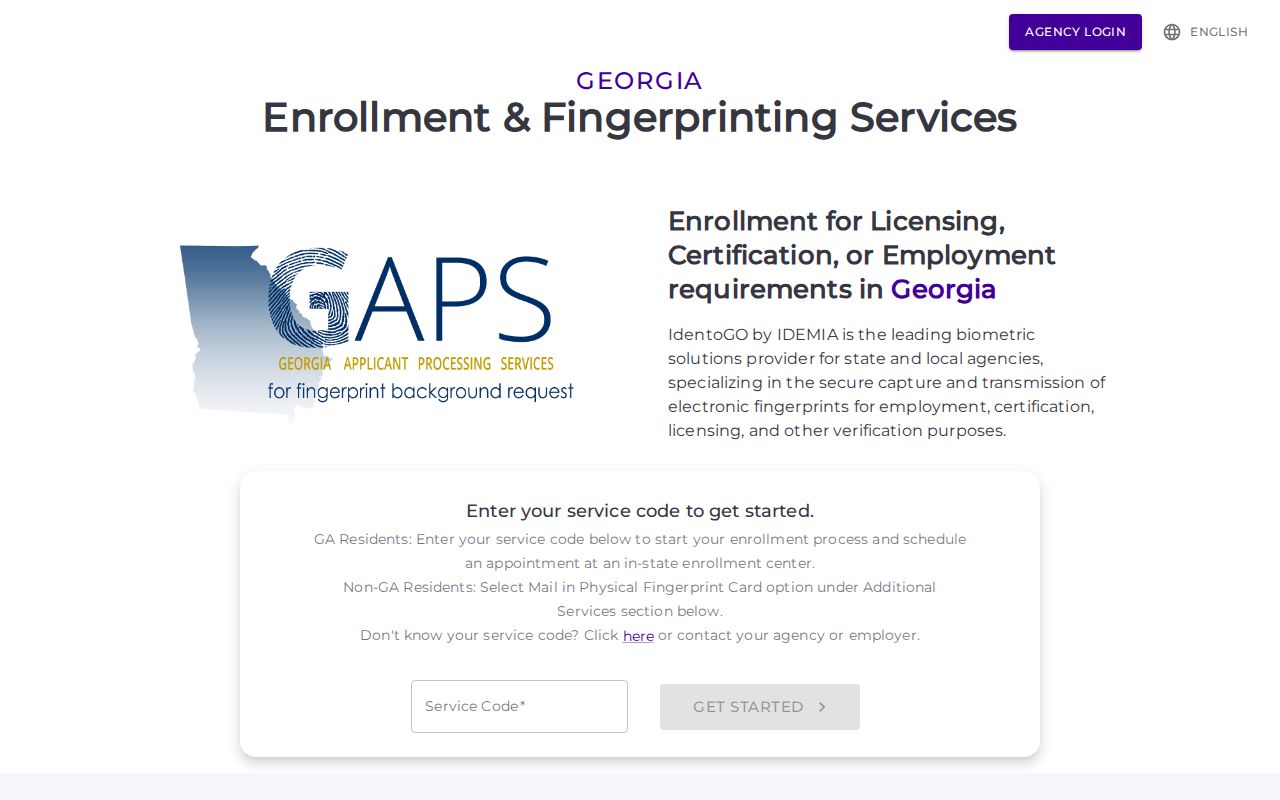
The appointment interface matters because a statewide fingerprint check cannot be replaced by a county name search. GBI states that authorized agency results are often available on the secure GAPS server within about 24 to 48 hours after fingerprints are submitted. The dated 2025 GCIC schedule lists ordinary totals of $39.99 for Georgia-only and $51.99 for Georgia and FBI checks, though current charges should be confirmed before registration.
Criminal Record Types
“Criminal record” can mean several distinct public documents. The creator controls where a request starts, and the record's stage controls what it can prove. Quitman County has no one-click local index that merges them.
- Incident and arrest reports come from the arresting agency and may contain a narrative, officer actions, and evidence references.
- Booking records come from the detention custodian and can show intake time, charge, bond, image, release, or transfer.
- Court files contain the accusation or indictment, docket events, pleas, orders, disposition, and sentence.
- Warrant records begin with a judge and require current confirmation from the issuing court and sheriff.
- Corrections and registry records come from GDC, supervision agencies, or the Georgia sex offender registry.
An incident report records an alleged event. A booking record captures custody at one point in time. Neither proves guilt. The clerk's judgment is the best source for the legal outcome of a prosecuted charge.
No Online Quitman Jail Roster
No official Quitman County jail roster, booking log, active local detention page, visitation vendor, or mobile app was found. The old jail at 115 Main Street is a historic building, not an operating detention center. It stopped jail service around 1965. Never use that address for inmate mail, deposits, or visits.
Call the sheriff at 229-334-3726 and ask whether the person is held, released, or transferred. A 2023 GBI release documents one Georgetown arrest that led to detention in Randolph County Jail, but that example does not prove every person follows the same route. Once the sheriff names the receiving facility, contact that facility for current custody and its own booking document. Use VINELink for supported notifications.
GDC Find an Offender is the separate channel for sentenced state offenders. It can search by GDC ID, case number, or name and may show status, facility, offense, sentence, photograph, and release-related data.
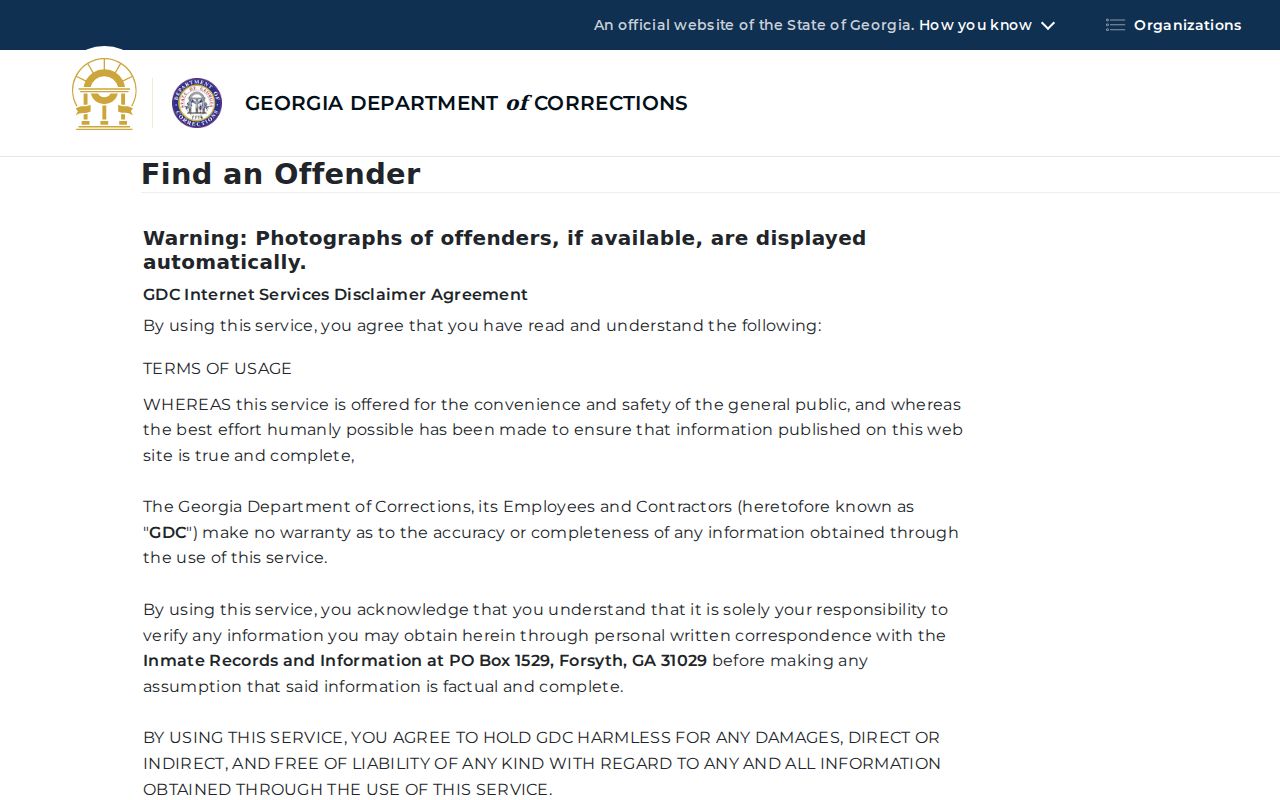
The GDC screen fills a state-custody gap but does not reproduce a sheriff report or Quitman court file. A recently booked person may not appear there. A person may also leave a county inquiry after transfer without having been released.
Inside a Quitman County Criminal Record
GCIC histories are person-centered. Court files are case-centered. Public views also omit sensitive identifiers that may exist in the official source. Read every field in context and confirm an ambiguous result with the custodian.
| Name & Identifiers | Legal name, aliases, date of birth, sex, race, physical traits, SID, or offender tracking number where authorized. |
|---|---|
| Arrest / Booking Data | Agency, date, place, arrest cycle, intake, holding charge, bond, release, or transfer. |
| Charges & Statutes | Alleged offense and code citation, which may change between arrest and prosecution. |
| Disposition | Dismissal, nolle prosequi, acquittal, plea, conviction, first-offender result, or other outcome. |
| Sentence | Custody, probation, fine, restitution, and concurrent or consecutive terms. |
| Custody / Supervision | GDC facility or status, release data, probation, or parole information when public. |
- Disposition
- The recorded outcome of a charge or case.
- Nolle prosequi
- A prosecutor's formal decision not to continue a charge.
- OTN
- The offender tracking number that ties records to an arrest cycle.
- First offender
- A Georgia disposition that may end without an adjudication of guilt after successful completion.
Avoid the Brooks County Trap
Quitman County and the City of Quitman are different jurisdictions. Georgetown is the county seat here. The City of Quitman lies in Brooks County, and its police, jail, and court results do not describe a Georgetown event. Add “Quitman County,” “Georgetown,” or ZIP 39854 to a search. Confirm the government domain and street address before relying on a result.
This distinction also affects state crime data. Select the actual reporting agency and year in FBI or GBI material. Do not merge Brooks County numbers with Quitman County. With only 2,235 residents counted in the 2020 Census, a few events can sharply change an annual rate, so raw counts and reporting coverage should accompany percentages.
Public Access Laws in Georgia
Georgia's Open Records Act presumes access to agency records unless an exemption applies. A written request should name the exact item, date range, event number if known, and desired electronic format. Ask for a cost estimate. The agency generally must respond within three business days when records are available, but that deadline requires a response, not complete production of a long video or archived file.
Active investigative material, juvenile information, victim-sensitive data, sealed or restricted files, and protected personal identifiers may be withheld or redacted. Ask for segregable public portions when only part of a record is exempt.
Key Statutes:
O.C.G.A. §§ 50-18-70 through 77 establish Georgia's open-record request and response framework.
O.C.G.A. § 35-3-34(d.2) permits public felony-conviction access with required identifiers.
O.C.G.A. § 35-3-35 governs authorized noncriminal-justice dissemination.
O.C.G.A. § 35-3-37 controls criminal-record correction and restriction.
O.C.G.A. § 42-1-12 sets registration and public registry rules.
Quitman Open-Records Fallback
The sheriff has no stand-alone records portal. Send a precise written request to the agency's designated open-records officer. Distinguish the incident narrative, arrest report, booking sheet, photograph, CAD entry, 911 audio, body-camera video, and warrant confirmation. Each is a separate record with its own review and retention issues. If GSP, GBI, or DNR created the report, request it from that agency even if the sheriff handled custody.
The county Action Center can help route a question, but it is not identified as the formal criminal-record portal. Its form asks for the issue type, description, and location, with optional contact fields. For a formal request, state that the request is made under the Georgia Open Records Act and ask for the designated officer and an advance estimate.
Note: The sheriff's site lists 229-334-3726, while the unified directory prints 229-334-3739; start with the direct sheriff number.
Sealed, Expunged, and Restricted Records
Georgia's main term is record restriction. Restriction limits GCIC disclosure for noncriminal-justice purposes but does not erase every clerk docket, agency report, or news account. Court sealing is a separate step for eligible court material. Juvenile histories have additional protection and are handled through Juvenile Court rather than a public GCIC history.
For arrests after July 1, 2013, contact the prosecutor about an eligible disposition. Older arrests generally use the pre-2013 route through the arresting agency. Obtain a certified disposition from the court, identify the precise arrest cycle, and include the arresting agency, arrest date, SID or OTN if known, and final result. Every charge in the cycle needs an accurate disposition. If GCIC remains wrong, provide documentation from the contributing agency because GCIC cannot simply rewrite another office's submission.
| Service | 2025 GCIC fee |
|---|---|
| Record restriction | $25 |
| Inspection/challenge with fingerprint card | $10 |
| Inspection including headquarters fingerprints | $25 |
| Headquarters fingerprinting only | $15 |
GCIC Is Not the Court File
The Georgia Crime Information Center overview identifies the state system behind criminal-history compilation, fingerprint identification, and related justice information. Local agencies, courts, prosecutors, corrections, probation, and parole contribute different events.
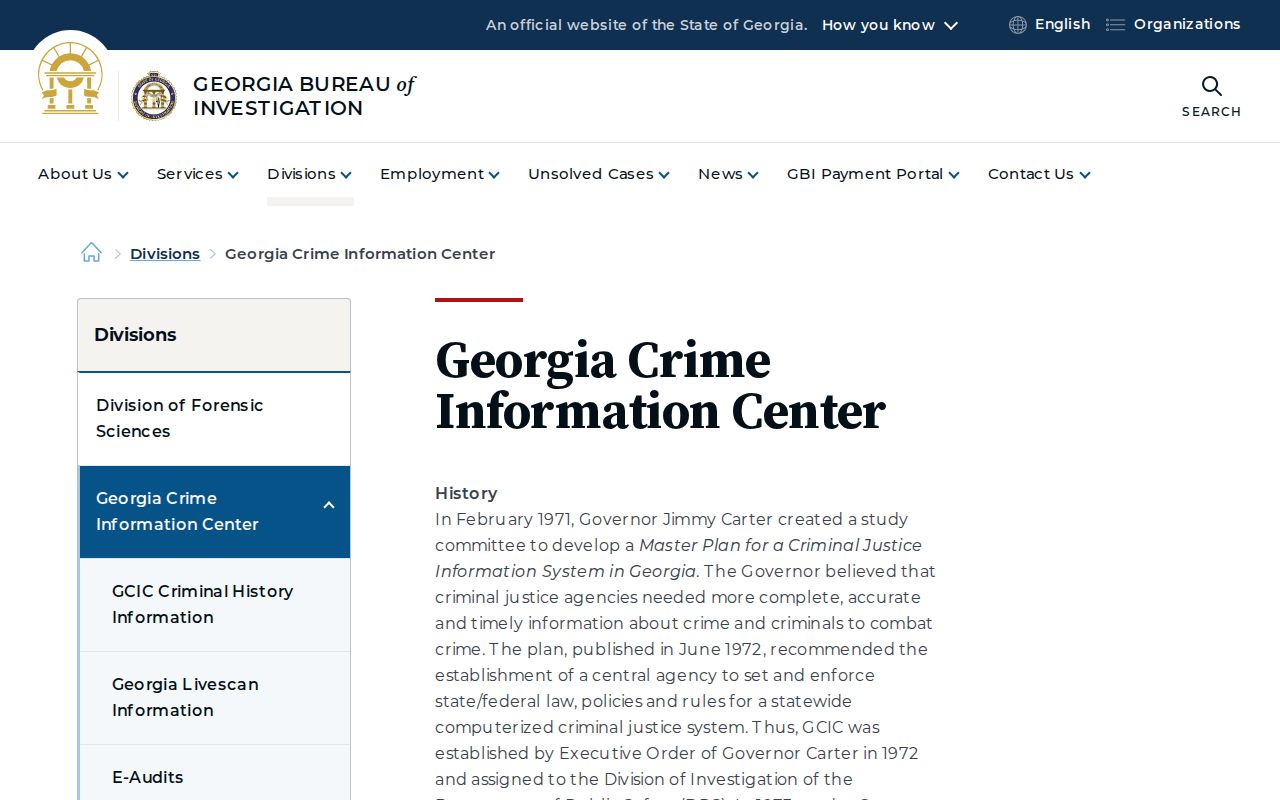
The state repository view helps connect an identity across arrest cycles, but a certified Quitman County judgment still comes from the court clerk. When a GCIC entry lacks the final outcome, obtain that disposition and follow the correction process. A public Felon Search result is narrower again, so “no record found” does not prove that no arrest, misdemeanor, out-of-state matter, or restricted event exists.
Historic Buildings, Current Record Roles
The Quitman County Courthouse at 111 Main Street remains the key judicial records address. Built in 1938 and 1939 with Public Works Administration support, the one-story brick courthouse is one of the county's two National Register-listed buildings. Its historic status does not change the clerk's current role. Filed accusations, indictments, docket entries, dispositions, and sentences still belong with the clerk rather than the sheriff or GCIC.
The adjacent Old Quitman County Jail at 115 Main Street creates a more serious records-search trap. Built in 1891, it stopped operating as a jail around 1965 and was later renovated. A judicial or county office in a former jail does not mean anyone is held there. Confirm present custody with the sheriff and ask where a detainee was transferred. Do not send inmate mail or arrange a visit based on the building's name.
Georgetown's Main Street offices serve a rural county of 151.24 land square miles. The 2020 population density was 14.8 people per square mile, and more than a third of residents were age 65 or older in the 2020 through 2024 estimate. Those facts make phone and counter access especially important when a web database is absent. They do not support assumptions about any person's record.
Quitman County Criminal Records by City
Georgetown is the county's only incorporated municipality and forms a consolidated government with Quitman County. There is no separate Georgetown police records desk. The sheriff handles all police functions, while Probate/Magistrate Court handles traffic and early warrant matters and the Superior Court clerk holds filed criminal cases.
Georgetown Criminal Records
County seat and sole incorporated place. Sheriff policing and county court channels serve the city.
The Georgetown criminal records page explains the consolidated city's local route, including incident requests, traffic questions, booking transfers, and the lack of a separate municipal lookup.